
CarPlay- ITU-T P.1100/ P.1110 In-car Communication & Siri Testing
A comprehensive introduction to the Apple CarPlay automotive integration platform, relevant ITU-T P.1100 / P.1110 standards, and the technical architecture of Siri voice assistant in in-vehicle applications. Applicable to automotive system engineering, communication testing, and technology validation.
Apple CarPlay Automotive Integration Platform Overview
Apple CarPlay (commonly referred to as CarPlay) is an in-vehicle connectivity platform developed by Apple. It enables drivers to safely and intuitively access navigation, communication, music, and voice assistant applications through their iPhone while driving.
CarPlay is not merely a screen projection interface. It integrates user interface design, human-machine interaction (HMI) specifications, and in-vehicle infotainment (IVI) system standards, forming a critical component of modern smart vehicle user experience.
Core Features of Apple CarPlay
1. Safety and Simplified Operation
CarPlay prioritizes driving safety in its interface design:
- Large, clearly visible buttons and simplified information display
- Optimized touchscreen and rotary control interaction
- Driver-focused visual layouts and audio prompts
These design elements allow drivers to operate the system without unnecessary distraction.
2. Deep Integration with the iPhone Ecosystem
When connected, CarPlay seamlessly integrates with applications and data stored on the user's iPhone, including:
- Contacts and message notifications
- Navigation (Apple Maps)
- Music streaming (Apple Music, Spotify)
- Calendar and reminders
All data interactions are protected by Apple’s security and privacy framework.
3. Siri Voice Control
CarPlay supports Siri voice assistant functionality for:
- Voice-activated navigation and route setup
- Making calls and replying to messages
- Controlling music playback
- Performing daily reminders and information queries
Siri enables drivers to maintain focus on the road through hands-free voice interaction.
Overview of ITU-T P.1100 / P.1110 Standards
The International Telecommunication Union – Telecommunication Standardization Sector (ITU-T) develops global standards to ensure consistency and interoperability in telecommunications systems and applications. Below are key standards relevant to automotive and real-time communication environments:
ITU-T P.1100
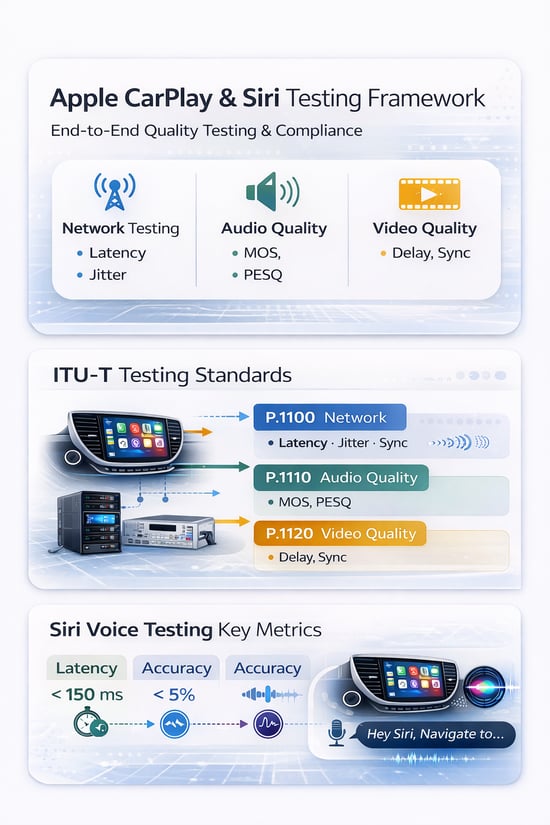
The ITU-T P.1100 series defines requirements for real-time audio and video interactive communication systems. It focuses on network performance and voice quality assessment, including:
- End-to-end delay and timing requirements
- Quality of Service (QoS) performance metrics
- Audio/video synchronization mechanisms
These standards support evaluation of communication performance in systems including in-vehicle connectivity interfaces.
ITU-T P.1110
ITU-T P.1110 focuses on quality assessment methodologies for interactive audio and video systems, including:
- Perceptual audio quality metrics
- User experience considerations
- Testing methodologies in real-world network and automotive environments
For evaluating CarPlay connection quality, network latency, and voice playback performance, P.1110 provides a structured methodology.
Siri Voice Assistant Technology and Automotive Integration
Siri is Apple’s voice assistant framework supporting:
- Natural Language Processing (NLP)
- Automatic Speech Recognition (ASR)
- Natural Language Understanding (NLU)
Within CarPlay systems, Siri typically enables:
Voice Navigation Interaction
Setting destinations, checking traffic conditions, or searching nearby locations through voice commands.
Communication Voice Control
Making calls and replying to messages without touching the screen.
Multimedia Control
Managing music or podcast playback, switching tracks, and adjusting volume.
Siri’s speech recognition engine applies adaptive Noise Suppression and Gain Control to compensate for in-vehicle background noise, ensuring high recognition accuracy while driving.
Importance of Laboratory Testing for Apple CarPlay
As automotive systems become increasingly complex, CarPlay and other integration platforms require professional testing and quality validation to ensure:
- Distortion-free communication and synchronized transmission
- High speech recognition accuracy in noisy environments
- Multimedia playback consistency and compatibility
- Reliable interoperability with vehicle hardware and network systems
As a third-party professional testing laboratory, Omniulabs provides services based on ITU-T standards and practical validation methodologies, including:
✔ CarPlay connectivity and communication performance measurement
✔ Audio and voice quality analysis
✔ System consistency and interoperability testing
FAQ
Q1: Which iPhone models support CarPlay?
Supported devices and iOS versions can be referenced through official Apple documentation.
Q2: Is Siri accurate in automotive environments?
Siri incorporates adaptive noise suppression and dynamic gain control, enabling high recognition accuracy in real driving conditions.
Q3: Are ITU-T P.1100 standards mandatory?
ITU-T standards are generally recommendation-based guidelines that support quality validation and performance benchmarking.
Conclusion
Apple CarPlay is more than an in-vehicle connectivity platform — it is a critical gateway to modern driving experiences.
By understanding CarPlay architecture, relevant communication and multimedia standards (such as ITU-T P.1100 / P.1110), and Siri’s voice technology foundation, engineering teams and product designers can more effectively design, integrate, and validate reliable, consistent in-vehicle connectivity systems.
Contact Us
- Email: service@omniulabs.com
- Phone: +886-2-7730-6037
- Address: 6F., No. 8-8, Ln. 169, Kangning St., Xizhi Dist., New Taipei City, Taiwan